But while the headlines focus on what will no longer be allowed—such as selling or renting homes rated F or G after 2030—the deeper truth is far more positive:
 Living in an energy-efficient home simply feels better.
It’s warmer in winter, cooler in summer, quieter, healthier and significantly cheaper to run.
And the monthly cost of the improvements required to reach these standards is far lower than many people expect.
This article will guide you through what changes, why it matters for both buyers and sellers, and how a proper energy assessment with iNMOspector can protect your investment and improve your quality of life.
 1. What Actually Changes in 2030?
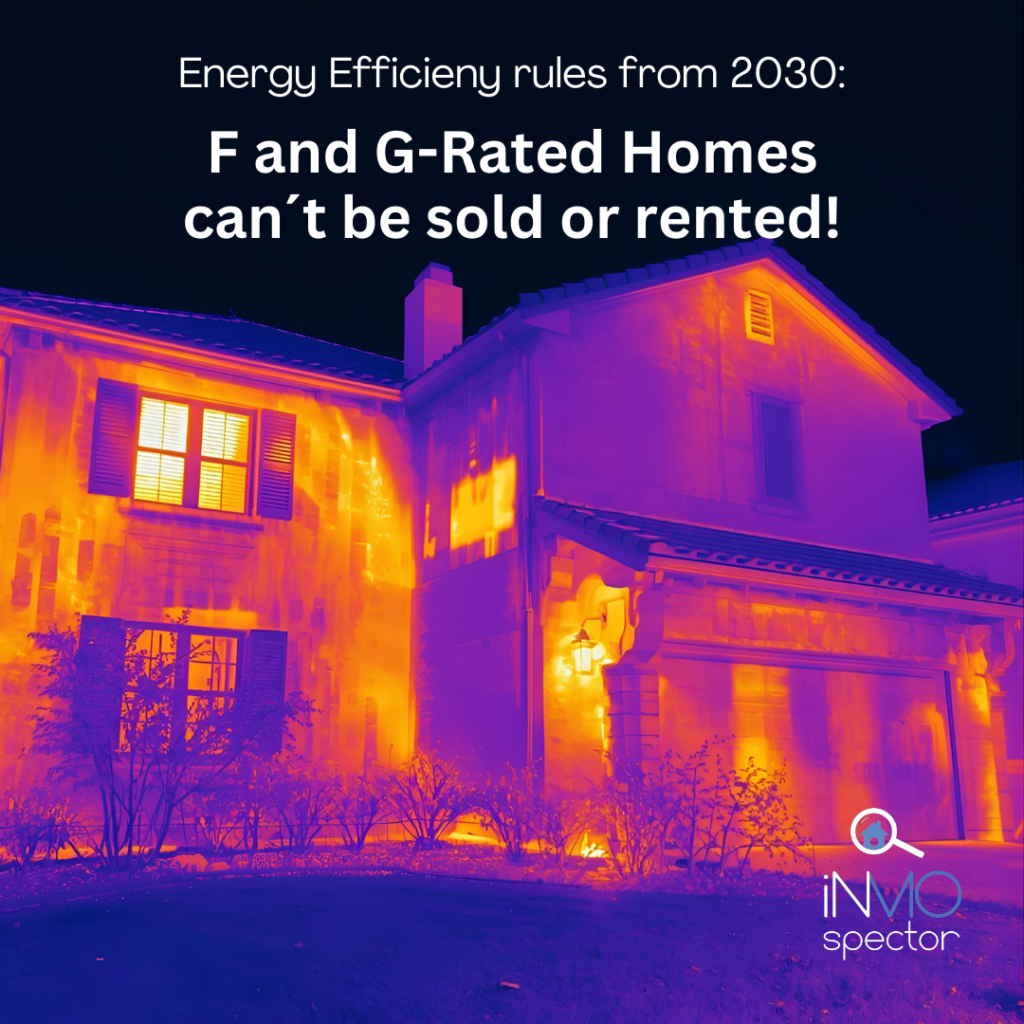
Starting 1 January 2030, Spain will implement EU-driven rules affecting every property placed on the market: Homes rated F or G cannot be sold or rented.
These properties must be improved before any transaction is legally possible.
 And by 2033, the minimum requirement rises to D.
This applies to:
Residential homes
Holiday properties
Rural houses and fincas
Apartments and penthouses
Investment rentals
Commercial properties
The aim is to bring Spain’s building stock progressively toward high-efficiency standards by 2050.
 2. Beyond the Law: The Personal Benefits of Living in an Efficient Home
Regulations aside, there is a human element many people overlook.
Efficient homes feel different.
They maintain a stable, comfortable temperature
They eliminate drafts and cold walls
They reduce dampness and mould risks
They block outside noise
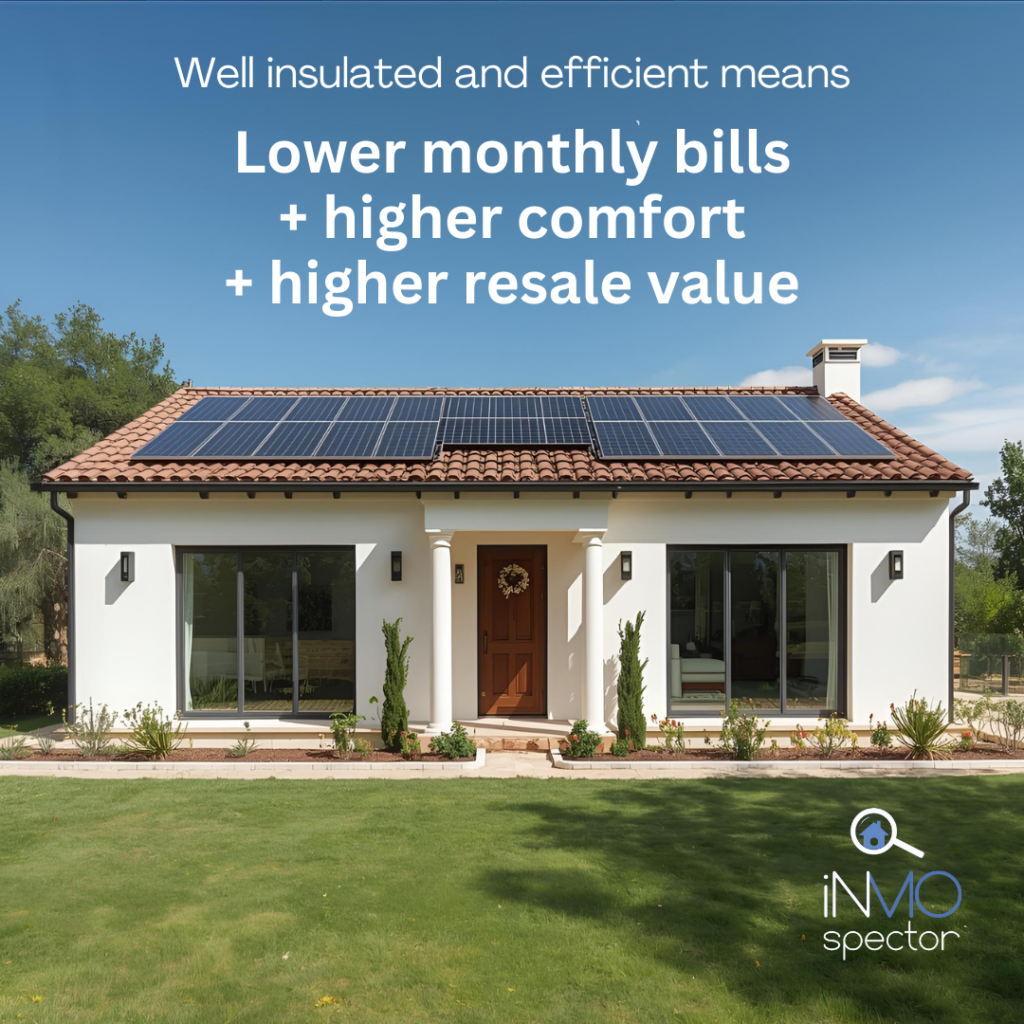
They consume less energy, saving money every month
For retirees and long-term residents—who make up over 80% of international buyers in Spain—comfort, health and predictable living costs matter enormously.
 And here’s the surprise:
The monthly cost of reaching these efficiency levels is often very low.
Insulation, window upgrades or heat pumps, when financed or amortized over the years of use, often cost just €10–€40 per month while delivering hundreds in annual savings.
Energy efficiency is not only greener and healthier—
 It is financially smart and emotionally rewarding.
 3. Why These Rules Matter for Buyers
International buyers—especially from Germany, the UK, Netherlands, France, Belgium and the USA—are increasingly seeking lifestyle, safety and long-term stability.
The new rules amplify those priorities.
Here’s what buyers need to know:
 An F or G home today is a financial risk
Even if you plan to renovate later, you must know:
what upgrades are required
how much they will cost
whether the home can reach E or D
if the structure allows efficient improvement
Without a proper study, you may face unexpected costs of €10,000–€60,000.
 Energy performance will affect future resale value.
Homes with strong ratings will sell faster and appeal more to Northern European buyers, who already prioritise efficiency.
 The Energy Certificate must be a
real technical assessment
The old €50 paper certificate, often done in 10 minutes, is now useless.
It won’t detect:
insulation problems
humidity
outdated heating systems
window inefficiencies
thermal bridges
mould risks
Buyers need clarity, not a symbolic document.
 It feels better to live in an efficient home—especially full-time.
This resonates deeply with the growing number of buyers relocating to Spain for retirement or remote work.
 4. Why These Rules Matter for Sellers
For owners contemplating a sale between 2025 and 2035, energy efficiency now affects:
→ Marketability
A home rated F or G will simply not be allowed on the market after 2030.
→ Sale price
Buyers will negotiate aggressively if upgrades are required.
A better rating increases perceived value.
→ Time on market
Efficient homes attract more interest, faster.
→ Your personal comfort today
Investing in energy upgrades is one of the few improvements you can enjoy now and still profit from later.
→ Monthly costs
Upgrades often significantly reduce heating, cooling and electricity bills.
In other words, even if you plan to sell in the medium term, the improvements benefit your life immediately.
 5. The Energy Certificate Must Become a Real Technical Study
The traditional EPC—often a quick visual inspection—is no longer enough.
A future-proof certificate must include:
 Thermal imaging
Envelope and insulation measurement
Window & glazing performance
Orientation and solar exposure
Humidity + ventilation analysis
HVAC efficiency
Feasible upgrade recommendations
Cost-benefit & ROI
Market value impact
Renovation project planning
Urbanistic and legal coherence
This is exactly how iNMOspector approaches energy efficiency:
as part of a complete technical, legal and market analysis.
 6. How iNMOspector Helps Buyers & Sellers
 For Buyers
Full technical inspection
Energy performance study
Moisture & structural checks
Urbanistic + legal review
Valuation & negotiation support
Renovation planning via iNMObuilder
German & English guidance through the entire buying process
Notary accompaniment
Arras & escritura legal review via partner lawyers
We help you avoid costly surprises and buy with full confidence.
 For Sellers
High-quality Energy Certificate (real study)
Improvement recommendations
Pricing strategy based on rating
Renovation options (windows, insulation, heat pumps, solar, etc.)
Building licences
Upgrade cost planning
Preparation for 2030 legal requirements
We help you sell faster, safer and at a better price.
 7. Should You Upgrade Now or Wait?
Here is the simple decision framework:
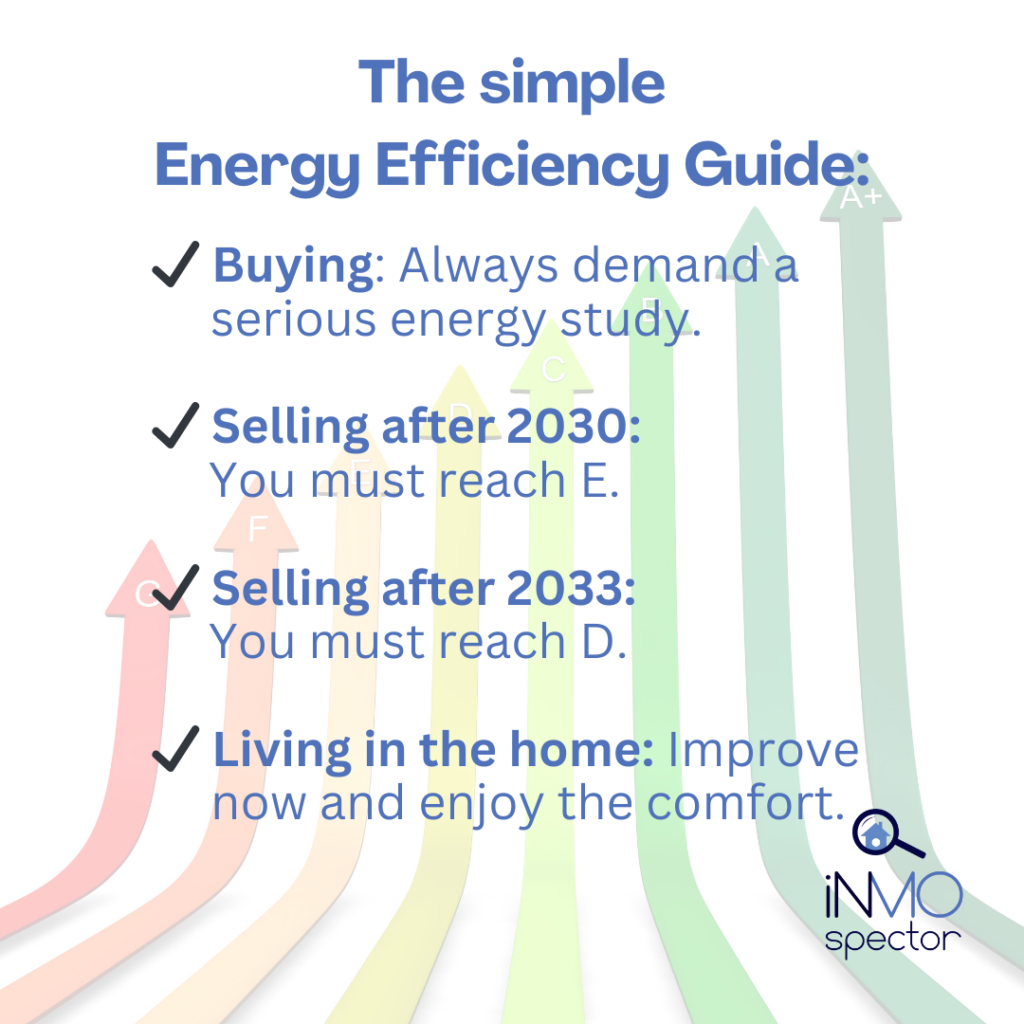
If you plan to sell
after 2030
You must reach at least E.
If you plan to sell
after 2033
You must reach D.
If you are buying today
Demand a serious energy study before committing.
If you plan to keep the home
Upgrade now — enjoy the comfort, reduced bills and improved health.
 Conclusion: The New Rules Are Not a Burden — They Are an Opportunity
Spain’s 2030 energy rules will redefine real estate, but they also bring something more meaningful:
A path toward healthier, more comfortable and more affordable living.
An energy-efficient home is not only easier to sell —
it is a joy to live in.
By transforming the Energy Certificate into a serious technical and strategic study, iNMOspector helps buyers and sellers make decisions with clarity, confidence and comfort.
 Ready to understand your property’s energy future? Contact iNMOspector today.