

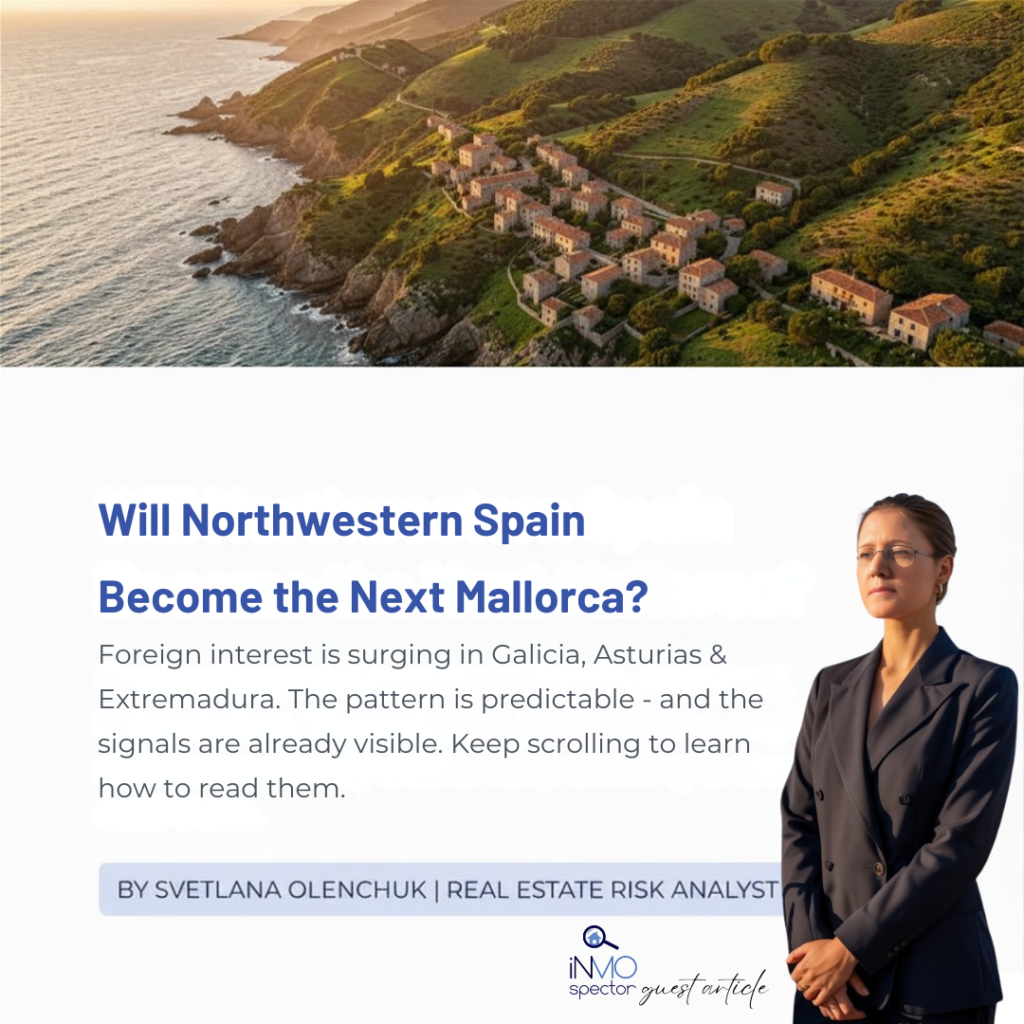
What foreign interest actually does to a local housing market, and how to read the signs early
By Svetlana Olenchuk | Independent Real Estate Risk Analyst
There is a question being asked quietly in towns across Galicia, Asturias and Extremadura. Locals ask it at kitchen tables and in town squares. Some foreign buyers arriving in those regions have started asking it too.
The question is: are we watching the beginning of something we cannot reverse?
It is a reasonable question. And it deserves a more precise answer than “it depends” or “it’s different here.”
Because it is not always different. There is a fairly predictable sequence to what happens when a region transitions from being unknown to being discovered, and from being discovered to being overwhelmed by demand. That sequence has played out before in Spain. It is visible in the data. And the signals that mark each stage are identifiable, if you know where to look.

This piece is for two audiences.
For foreign buyers considering property in Spain’s northwest: it is a guide to understanding what you are actually buying into, and what questions to ask before committing.
For local residents watching the change happen around them: it is an attempt to name the dynamics clearly, so that the conversation about what comes next is grounded in what has actually happened elsewhere.
Part One: What actually happens when a region gets discovered
The pattern is not random. Regions that attract foreign buyer interest tend to move through the same stages, driven by the same mechanisms. Understanding those stages is the starting point for both groups (buyers and residents alike).
A key caveat: these stages do not apply evenly across entire regions. They show up first in specific municipalities, towns, and price bands.
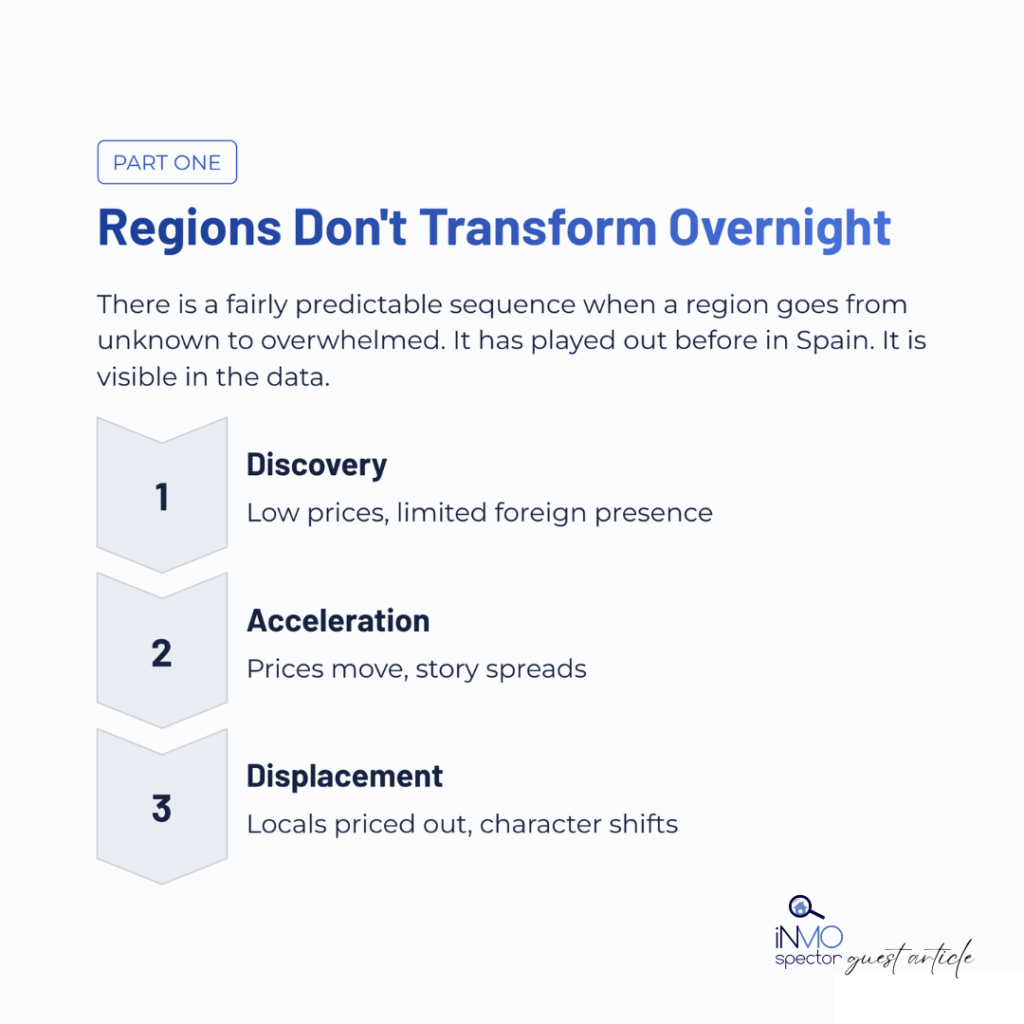
Stage one: the discovery phase
A region has low prices, genuine character, and limited foreign presence. Word spreads through personal networks, through media coverage, and through social media. Early buyers arrive: typically people with some connection to the place, or people deliberately seeking somewhere that has not yet been transformed.
Prices are low. Transaction volumes are modest. Locals and foreigners exist in the same market, competing for the same properties, but at price levels local incomes can still support.
Some micro-markets in Galicia, Asturias and Extremadura appear to sit here today.
Stage two: acceleration
More buyers arrive. Prices begin to move. The story of the region spreads further: it appears in property supplements, in relocation guides, in conversations at dinner parties in London, Berlin and New York. Developers notice.
At this stage, prices are still affordable to many locals. But the trajectory is established. And the local buyer pool begins to thin at the margins.
Stage three: displacement
Foreign demand can become one of the dominant forces in the market. Local buyers can no longer compete across most of the price range. Rental properties are converted to short-term lets. The character of town centres shifts. Long-term residents find themselves in a housing market that no longer prices them in.
This is broadly where the Balearics are. Parts of coastal Andalusia. Significant areas of the Costa Blanca. The process there is unlikely to reverse in the short term, not because it could not have been managed differently at an earlier stage, but because by the time the consequences became visible to enough people, the market had already moved.
Mallorca did not become Mallorca overnight. It moved through the same stages that some parts of northwestern Spain are entering now. The difference is time, and whether the signals are read early enough to matter.
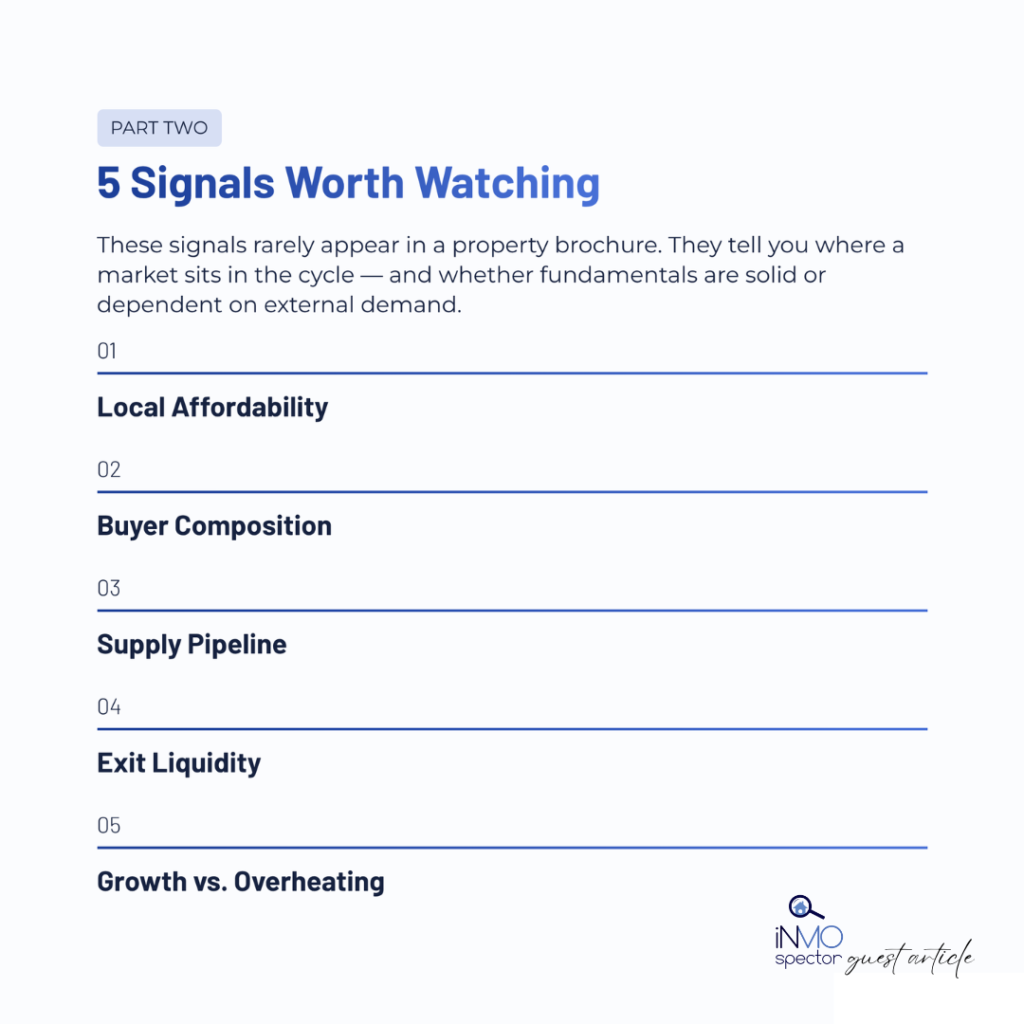
Part Two: The five signals worth watching
The transition between stages is not invisible. There are measurable signals that indicate where a market sits in this sequence and whether the fundamentals underneath price growth are genuinely solid, or whether the market is beginning to depend on continued external demand to sustain itself.
These are the signals that rarely appear in a property brochure or an agent’s market overview. They are the signals that matter most.
1. Local affordability: who can still buy here?
The most important early indicator is not price itself. It is the ratio of local incomes to local property prices, and the direction in which that ratio is moving.
Since 2024, Spain’s housing market has continued to run ahead of affordability. House prices are still rising strongly while access to housing has become more difficult, especially for lower-income households and in urban and tourist areas. Banco de España’s latest indicators show house prices still rising at double-digit rates in 2026, while rent inflation runs considerably lower. One Banco de España-linked analysis shows that rent burden is especially heavy for low-income households, reaching around 45% of gross income in that group.
In the established coastal markets, this process is already advanced. In the northwest, it is earlier. But in some municipalities, the direction of travel is already established: prices have moved faster than wages for several consecutive years.
Why does this matter to a foreign buyer, not just to a local resident? Because when locals can no longer compete in the housing market, the exit market for foreign buyers becomes narrower. In year ten, when a foreign buyer wants to sell, the buyer pool they are selling into includes, or does not include, local Spanish purchasers. A market that has priced out its local population is a market with a smaller, more fragile buyer pool. That is a risk that shows up in liquidity before it shows up in prices.
What to check: Is average property price in this municipality rising faster than local wages? Is the gap larger than it was five years ago?
What to check: What share of recent transactions involved local Spanish buyers rather than foreign buyers?
2. Buyer composition: where is demand actually coming from?
Foreign buyer demand in Spain is not a single, homogeneous group. It is several distinct segments, each with different motivations, different price sensitivity, and different staying power.
Foreign buyers remained an important part of the market in 2025, but the mix and regional distribution continued to evolve. According to the General Council of Notaries, foreigners purchased 138,254 homes across Spain in full-year 2025, virtually unchanged from 139,433 in 2024. H1 2025 alone saw 71,155 foreign purchases, representing 19.3% of all transactions in that period.
The regional picture tells a sharper story. Notaries data for H1 2025 shows that foreign buyer activity increased fastest in precisely the regions this article is concerned with: Asturias saw a 30.8% year-on-year rise, Galicia 14.3%, and Extremadura 10.6%. Meanwhile, the Balearic Islands (the very markets locals in the northwest fear becoming) recorded a 6.8% decline. Demand is not growing uniformly. It is redistributing, and the northwest is currently on the receiving end of that redistribution.
The nationality data adds further texture. Notaries’ regional buyer maps for H2 2025, published by Spanish Property Insight in May 2026, show Americans now among the top two non-resident buyer nationalities in six Spanish regions, including Galicia and Asturias. Many of these buyers have family roots in the diaspora communities that emigrated from Galicia and Asturias to the Americas in the early and mid-twentieth century. Germans, meanwhile, have become prominent in Cantabria, Galicia and Asturias as well, even as they continue to dominate the islands.
Diaspora-linked demand has a particular character. It is not purely speculative or yield-driven. It comes with genuine emotional ties to place. In some ways, this makes it more stable than the pure investment demand that drove earlier coastal cycles.
But it is also a finite pool. It is concentrated in specific nationalities and sensitive to conditions in the buyers’ home countries: economic cycles, exchange rate movements, and shifts in political sentiment about living abroad. A market whose growth depends primarily on one or two buyer segments carries different risk than one with genuinely diversified demand.
For local communities, the buyer composition question matters for a different reason: it shapes what kind of demand is entering the market, and whether that demand produces permanent residents, seasonal occupants, or purely investment-driven owners. These three outcomes produce very different results for town character, rental housing availability, and local commercial life.
What to check: Are foreign buyers in this micro-location primarily one or two nationalities, or genuinely diversified?
What to check: Are buyers primarily end-users, second-home purchasers, or investors? The proportion matters for what the market looks like in five years.
3. Supply pipeline: what is being built, and for whom?
One of the most reliable leading indicators for where a market will be in three to five years is the volume of development activity being permitted today.
Banco de España data shows Spain had a housing shortage of roughly 325,000 homes after supply lagged household formation in 2022 and 2023. Residential investment remains low relative to past decades and below euro-area levels. This national supply constraint is one reason prices have remained firm in many parts of Spain despite broader affordability pressure.
But supply dynamics vary sharply at the regional and municipal level. In established coastal markets, supply responded to foreign buyer demand, sometimes slowly, sometimes in sudden bursts that created oversupply at specific price points. In emerging markets, the supply response has not yet happened at scale.
When it does happen (and in regions attracting sustained foreign interest, it eventually does), the character of the supply matters as much as the volume. Development targeting foreign buyers typically does not address local affordability. It competes for the same land and planning permission that might otherwise produce housing for local residents. In some municipalities, this dynamic has accelerated the affordability squeeze rather than relieving it.
The sequence worth watching is this: prices rise, developers notice, planning permissions are filed, construction begins. Two to three years later, new stock arrives into the market at the same time that some of the early buyers are looking to exit. If local demand has not deepened enough to absorb both the new supply and the resale inventory, prices soften. The people most exposed are those who bought at the peak of the discovery phase, assuming the momentum would continue.
What to check: What is the volume of new planning permissions in this municipality relative to recent annual transaction volumes?
What to check: Is the new development being built targeting local or foreign buyers? Does it add to the affordable housing stock or compete with it?
4. Exit liquidity: how long does it actually take to sell?
This is the figure that almost no property brochure includes. It is the one that matters most to any buyer with a finite hold period.
Exit liquidity measures the realistic probability of selling within a defined time window (30 days, 90 days, 180 days) at or near the asking price. It is determined by the depth and velocity of comparable transactions in the micro-location: how many similar properties have sold recently, how long they took, and what discount to the initial listing price was ultimately accepted.
In Spain’s most liquid markets (such as central Madrid, prime Barcelona districts, and established Marbella zones) exit liquidity is usually stronger than in smaller or emerging markets. In those markets, there is genuine transaction depth. Multiple buyers compete. A well-priced property sells within weeks.
In emerging regions, a market can feel liquid during its discovery phase, but resale conditions may be weaker once the early buyer wave has passed. The market is easy to buy into: demand is rising, sellers are motivated. The test comes when the positions reverse: when the first wave of buyers becomes sellers, and the question is who buys from them.
For buyers considering property in the northwest today, this is not an abstract risk. It is the central question: in ten years, when you want to sell, who is the buyer? Are there enough of them? And how long will it take?
What to check: How many comparable transactions have closed in this municipality in the last six months? Is that number rising or falling?
What to check: What is the typical discount between initial listing price and final sale price in this area?
5. The difference between a growing market and an overheating one
Not every market showing rapid price growth is overheating. Some price increases are structurally supported: genuine undersupply, improving local employment, infrastructure investment, diversified demand. These markets can sustain growth over a multi-year horizon without a sharp reversal.
Others are running on momentum: prices are rising because prices are rising, because buyers are arriving because other buyers have arrived. These markets are more fragile, because the mechanism sustaining them (confidence and narrative) is reversible in a way that genuine structural supply constraints are not.
A market with strong fundamentals tends to show a mix of local and foreign buyers, constrained new supply, and liquidity that remains healthy across different phases of the cycle, not just during the upswing.
A market running on momentum tends to show locals already priced out, demand concentrated in a few buyer segments, a supply pipeline beginning to respond to prices, and exit liquidity that has not yet been tested at scale.
The signals above do not tell you the answer with certainty. But they tell you which side of this line a specific market is on, and whether the price you are being asked to pay is supported by something durable, or by something that depends on the next wave of buyers arriving.
Part Three: What this means for both sides of the conversation
For local communities in northwestern Spain
The concern that places like Galicia and Asturias could follow a Mallorca-like path is legitimate. It is not fearmongering. It is based on a documented pattern that has repeated in multiple Spanish regions.
But the pattern is also not inevitable. What determines whether a region follows the full cycle is not primarily the arrival of foreign buyers. It is whether the policy and planning response is fast enough, and coherent enough, to shape how that demand integrates with the local market.
The municipalities that have managed this best are those that tracked the signals early: monitoring affordability ratios, watching supply pipeline composition, maintaining housing stock accessible to local incomes alongside the market housing that foreign buyers compete for. The municipalities that managed it least well are those that noticed the problem only after it had become irreversible at the planning and pricing level.
There is something else worth naming directly. When displacement happens faster than communities can adapt, the result is not just a housing problem. It is a social one. Hostility toward foreign buyers, expressed through protest, political pressure, and the kind of daily friction that makes a place feel unwelcoming, is already visible in parts of Spain where the cycle has run furthest. The Balearics, parts of the Canaries, areas of Barcelona and the Costa del Sol have all seen organised resistance to foreign ownership and short-term letting. That hostility is not irrational. It is a response to a real experience of displacement. And it is a signal, for both residents and incoming buyers, that the social contract around housing in that place is under serious strain.
There is also an asymmetry worth acknowledging.
The communities of Galicia and Asturias have their own history of emigration. For generations, people left these regions in search of economic opportunity, building lives in Germany, Switzerland, Latin America, and elsewhere while maintaining ties to home and often sending money back to support family members who remained.
Many of the buyers arriving today are moving in the opposite direction. They are drawn by lifestyle, affordability relative to their home markets, climate, or retirement considerations. They are not leaving because they must. They are arriving because the region offers a quality of life that is increasingly difficult to obtain elsewhere at the same price.
This asymmetry does not make foreign buyers unwelcome. But it helps explain why the welcome can sometimes feel conditional.
The social tension that emerges in housing markets under pressure is not simply resistance to outsiders. It is often a response to a specific form of inequality: the perception that the place local people could no longer afford to remain in is becoming less affordable still because it represents value to buyers whose purchasing power originates elsewhere.
The only durable solution is integration in the fullest sense of the word. Not simply purchasing property, but participating in the life of the community: learning the language, engaging with local culture, supporting local businesses, and becoming part of the social fabric rather than importing a parallel lifestyle into it.
That is not a policy solution. It is a human one. And in the long run, it is often the difference between a region that successfully absorbs new arrivals and one that gradually comes to feel occupied by them.
Foreign interest in a region is not inherently destructive. It brings economic activity, investment in renovation of empty stock, and in some cases, the reversal of rural depopulation that has been draining these regions for decades. The question is whether it is managed as a force that integrates with the local housing market or one that displaces it. Whether that distinction is made early enough is what determines the outcome.
For foreign buyers considering the northwest
Spain’s national housing fundamentals remain broadly supportive, but affordability pressure is rising and regional differences are significant. The main risk is not Spain as a whole, but buying into the wrong micro-market at the wrong price.
Most buyers considering the northwest already know why they want to be there. The question is not whether the region is attractive (and it clearly is). The question is whether the specific market they are entering is still in a stage where the fundamentals support the price being asked, or whether it has already moved into a later stage where the price reflects momentum and narrative rather than structural value.
The buyers who make the strongest decisions are not the ones who read the most market reports. They are the ones who ask the right questions at the right stage, before capital is committed and not after.
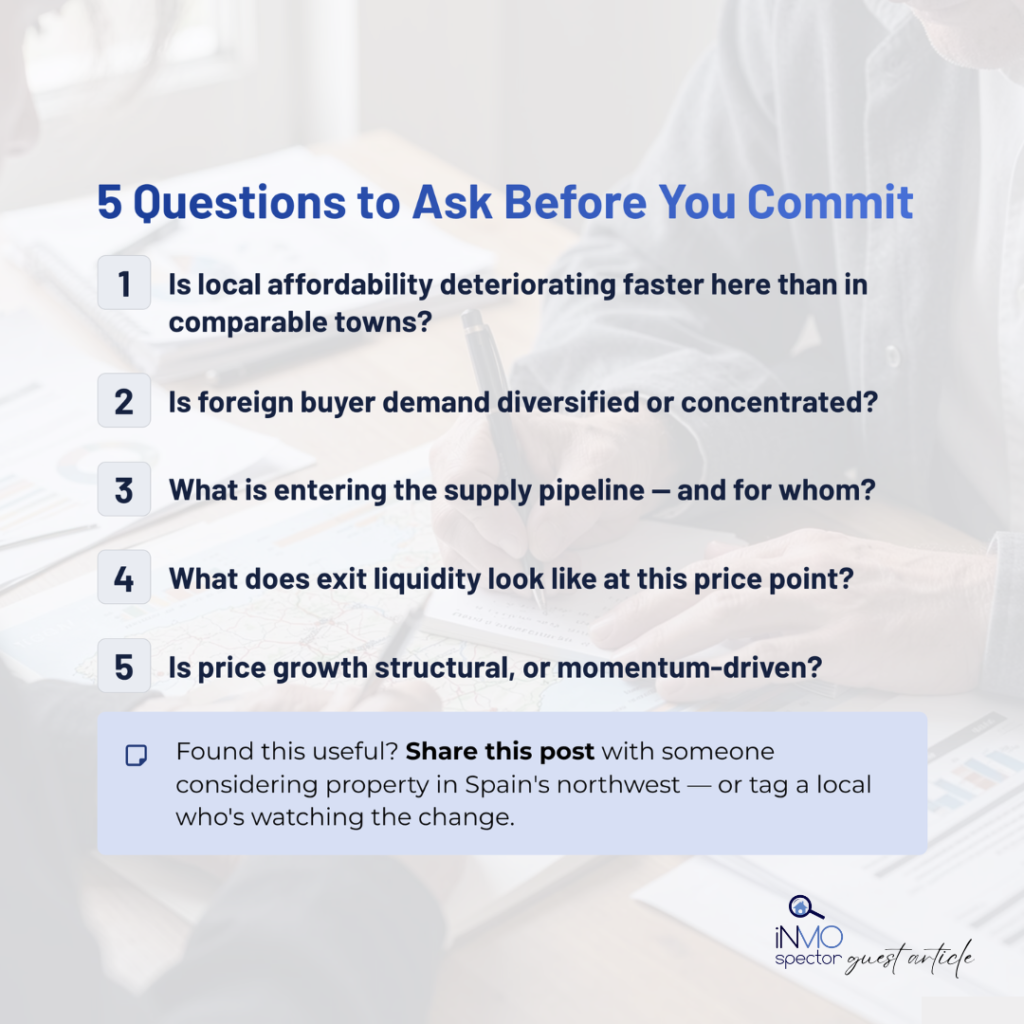
The questions worth asking before you commit
Whether you are a buyer evaluating a specific property or a local resident trying to understand the dynamics around you, these are the questions that cut through the noise:
Is local affordability deteriorating faster here than in comparable municipalities?
Is foreign buyer demand in this area diversified, or concentrated in one or two nationalities?
What is entering the supply pipeline over the next two years, and who is it being built for?
What does exit liquidity actually look like at this price point, not in the current market but in a normal one?
Is price growth here driven by structural factors, or by the same momentum that drove earlier coastal cycles?
These questions do not always have comfortable answers. But they are the right questions, for buyers who want to make a sound decision and for communities who want to understand what is happening before it becomes irreversible.
About the author
Svetlana Olenchuk is an independent real estate risk analyst specialising in cross-border acquisitions. She works with foreign buyers, buyer’s agents, wealth managers and family offices who need an independent second layer of analysis before committing capital in unfamiliar markets. Her work covers yield verification, market stress-testing, buyer composition analysis, exit liquidity assessment and supply pipeline risk, using transaction-level data rather than broker or developer projections.
Data sources: Banco de España Housing Market Indicators, June 2026; INE; MIVAU; General Council of Notaries Spain, full-year 2025 and H1 2025 regional data; CaixaBank Research; Spanish Property Insight, ‘Who bought where in H2 2025?’, May 2026; and current market transaction sources.
This article is for informational purposes only. It does not constitute investment or legal advice.