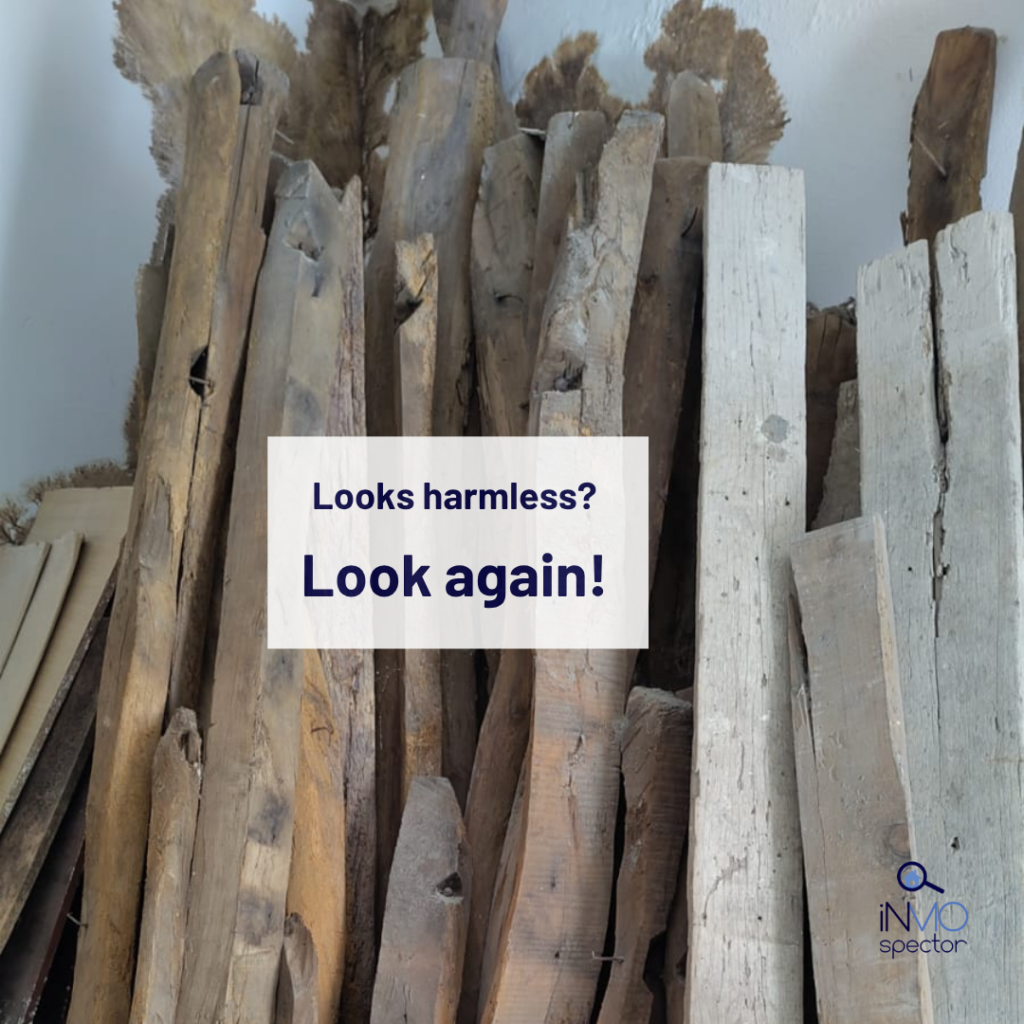
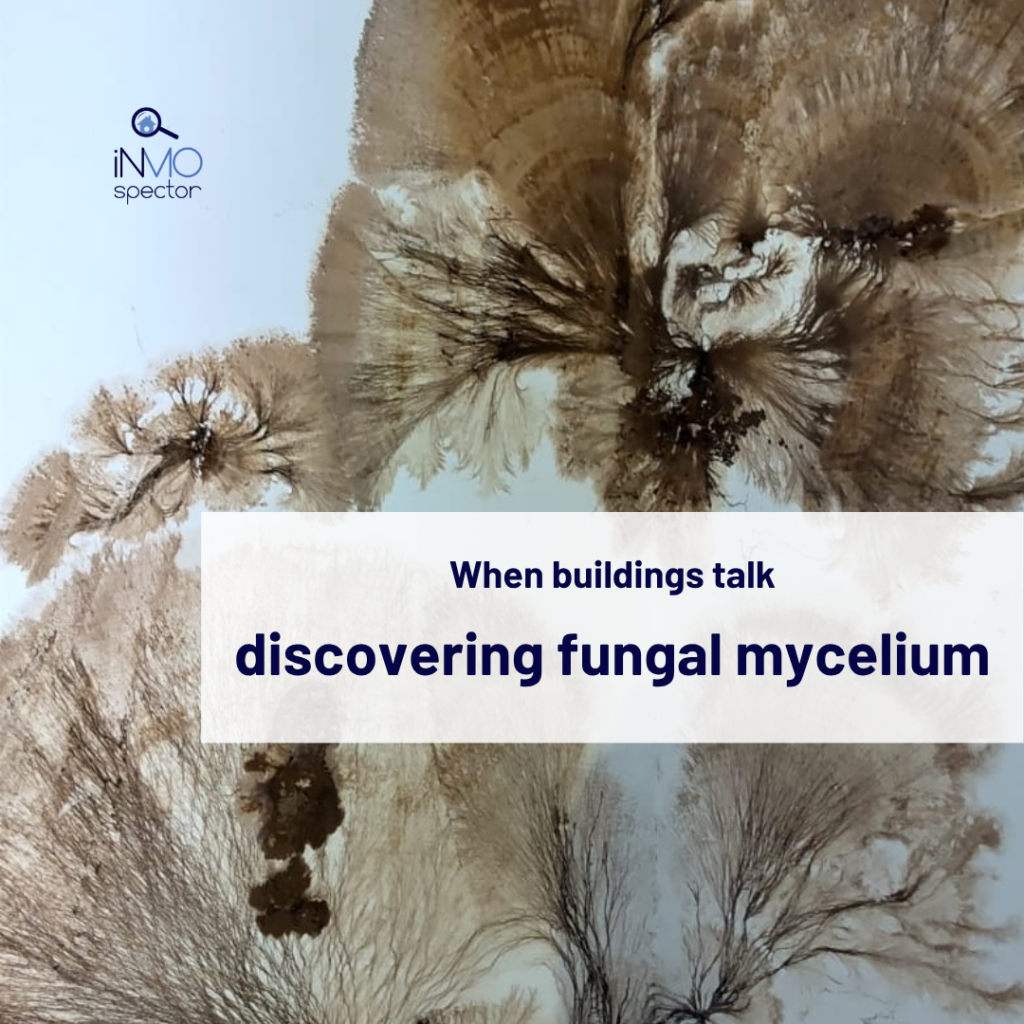
Some of the most important things a building can tell you aren’t visible from the street, or even from a normal viewing. They’re in the corner of a basement nobody spends much time in, growing quietly out of something as unremarkable as a stack of stored wood. That’s exactly where we found what you can see in the photos accompanying this article: sheets of fan-shaped fungal mycelium, some patches nearly a metre across, radiating out from dark, root-like strands that had crept up the wall to a total height of almost 3 metres.
It’s a striking, almost geological-looking thing. It’s also one of the most damaging organisms a building can host: dry rot, scientifically Serpula lacrymans, known in Spain and Galicia as “mérula.” Once we traced and eliminated the moisture source that let it grow, we made a deliberate choice to leave the specimen exactly as it dried out — not as a curiosity, but as a real, unstaged example of exactly the kind of defect an independent technical inspection exists to catch.
What dry rot actually is, and why it’s different from ordinary damp or mould
Most people who’ve dealt with a damp property are familiar with surface mould — the black or green staining that shows up on a cold wall or a poorly ventilated bathroom ceiling. Dry rot is a different, and considerably more serious, problem. It’s a wood-decay fungus that needs timber with a moisture content above roughly 20%, combined with still, warm, poorly ventilated air, to establish itself. In this case, that starting point was ordinary: wood stored directly on the floor of a damp basement, with no airflow underneath or around it, left there long enough for its moisture content to climb well past that threshold without anyone noticing.
What makes dry rot particularly dangerous, compared to ordinary wet rot or surface mould, is mobility. The dark strands you can see radiating across the wall in these photos are called rhizomorphs — root-like structures that can conduct water and nutrients not just through timber, but through brick, mortar and plaster. That means the fungus can travel several meters away from the original source of dampness and begin attacking completely dry, structurally sound timber elsewhere in the building. In this instance, a colony that began on a stack of stored boards had, by the time it was found, spread across the corner and climbed the wall to a height of nearly 3 metres — a scale that gives some sense of how long it had been established, and how far it can travel once it takes hold. This is exactly why dry rot has a reputation among building professionals as something that “hides” — by the time it’s visible at this scale, it has often already spread well beyond where it started.
The structural and health risks
Left unaddressed, dry rot breaks down cellulose and hemicellulose — the structural components of wood — leaving timber brittle, discoloured, and prone to cracking into small, cube-like blocks. This isn’t cosmetic. Affected timber loses much of its load-bearing strength, and in advanced cases this can mean sagging floors, weakened beams, and genuine structural risk in a property that may have looked completely sound from the outside. Once rhizomorphs have crossed from a pile of stored wood onto masonry and travelled several metres, as they did here, the risk is no longer confined to whatever timber was originally damp — it extends to any structural wood the strands reach along the way.
There’s a health dimension too. While dry rot itself isn’t considered directly pathogenic in the way some toxic moulds are, it has been associated with respiratory irritation and allergic reactions in sensitive occupants, and — just as importantly — its presence is a strong signal of the kind of chronic, poorly ventilated damp that tends to favour other, more clearly harmful moulds as well. If you find one, it’s worth assuming the underlying conditions may be supporting more than just what’s visible.
How to spot it before it looks like this
The good news is that dry rot rarely appears overnight, and there are warning signs long before it reaches the scale shown in these photos:
A persistent musty, damp smell is usually the earliest indicator — often noticeable before anything is visually obvious. Timber that looks shrunken, darkened, or has begun to crack into small cubes is a clear sign of advanced decay. Skirting boards or floorboards that feel unexpectedly soft or spongy under light pressure deserve a closer look. Cotton-wool-like white or greyish growth in corners, especially near stored wood, can be an early-stage mycelium mat before it forms the more dramatic fan shapes seen here. And perhaps most importantly: any basement, cellar, bodega or crawl space with little to no airflow — particularly one where wood, cardboard or other organic material has been stored directly on the floor or against an outside wall — is a location worth checking specifically, not just glancing at.
For anyone viewing a property, especially an older one with a basement, enclosed ground floor, or traditional stone construction common across Galicia, Asturias, Cantabria and Extremadura, it’s worth spending a few extra minutes in exactly the spaces most viewings skip: basements, under-stair cupboards, and behind anything stored against an external wall — firewood, spare boards, boxes, old furniture.
Prevention: the good news is that it’s genuinely preventable
Dry rot has one non-negotiable requirement — sustained moisture — which means consistent ventilation is by far the most effective form of prevention. That includes cross-ventilation in enclosed spaces, extractor vents in bathrooms and kitchens, and — critically — never allowing basements or crawl spaces to become fully sealed boxes with no airflow at all, even when the temptation is to close everything up to “keep the cold out.” Just as important, and often overlooked: never store wood, firewood, cardboard or other cellulose-based material directly on a damp floor or against an outside wall in an unventilated space — that combination is exactly how a colony like this one gets started. Fixing leaks, rising damp, and condensation issues promptly, rather than deferring them, matters more than almost anything else, since dry rot generally can’t establish itself in timber that’s kept reliably below that roughly 20% moisture threshold. A basic moisture meter, used during a viewing or a routine check, will catch far more than the naked eye or nose alone — though by the time a smell is noticeable, it’s usually worth investigating further regardless.
What happened in this case
Once we identified and eliminated the source of the damp, the fungus lost the moisture it needed to keep spreading. Rather than remove it immediately, we made the deliberate choice to preserve it in situ, now dried out and inert, precisely because it’s such a clear, real illustration of what can grow from something as ordinary as a pile of stored wood left in the wrong spot. It’s worth noting that even dried, dormant dry rot can in principle reactivate if moisture returns, so a specimen like this would still be fully removed as part of any renovation — preserving it here was a deliberate, controlled decision for documentation, not a recommendation to leave dry rot in a property you plan to live in.
Why this matters if you’re buying, or already own, property in Spain
This is exactly the category of defect that an independent technical inspection is designed to catch — the kind of thing that doesn’t show up in listing photos, doesn’t come up on a normal viewing, and can sit quietly for years in an under-used basement behind a stack of forgotten firewood. For international buyers weighing a property purchase, often from a distance and in a second language, this is precisely where an independent set of eyes pays for itself: not by telling you a property is good or bad, but by giving you the facts — moisture readings, visual findings, plain-language explanations — before you commit, so any negotiation or repair budget reflects reality rather than guesswork.
If you’re currently searching for a property, in the process of buying, or simply wondering what might be growing behind your own stored boxes or firewood, we’re happy to take a look. Independent technical inspections, urbanistic reports, and full building assessments are exactly what we do — across Galicia, Asturias, Cantabria, Extremadura, and throughout Spain.