“Can I extend the house?”
It’s one of the first questions we hear, usually followed by a few more. Can I close in the terrace or add a galería? Can I build a pool, a garage, a small guest house on the land? Can I sink a pozo so I have my own water? Can I turn the old stable into a bedroom? And the question behind all the others: is what’s already there legal, or at least legalizable?
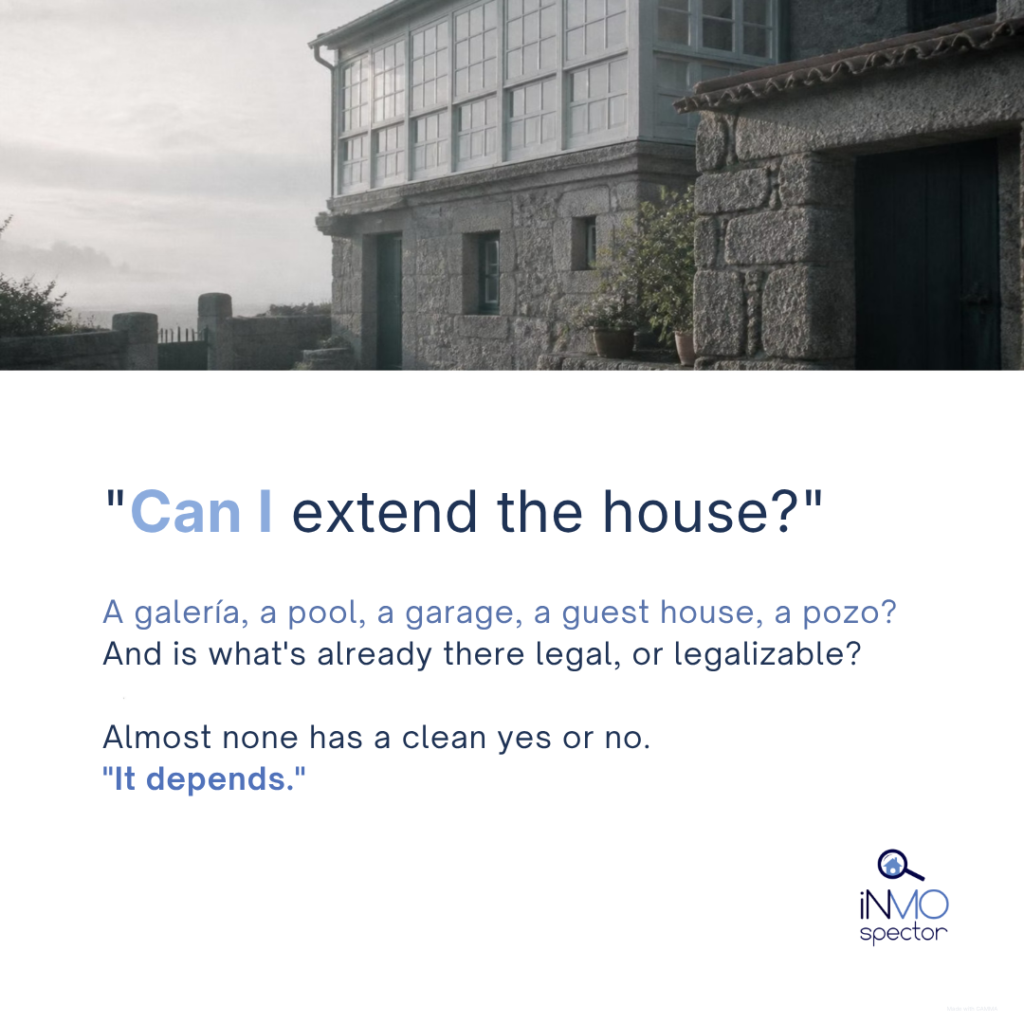
These are exactly the right questions to ask before you buy. The answers decide whether the house you’re looking at can become the home you have in mind. But there’s something buyers rarely hear upfront: in Spain, almost none of these questions has a clean yes or no. The honest answer is usually “it depends”, and it’s worth understanding what it depends on.
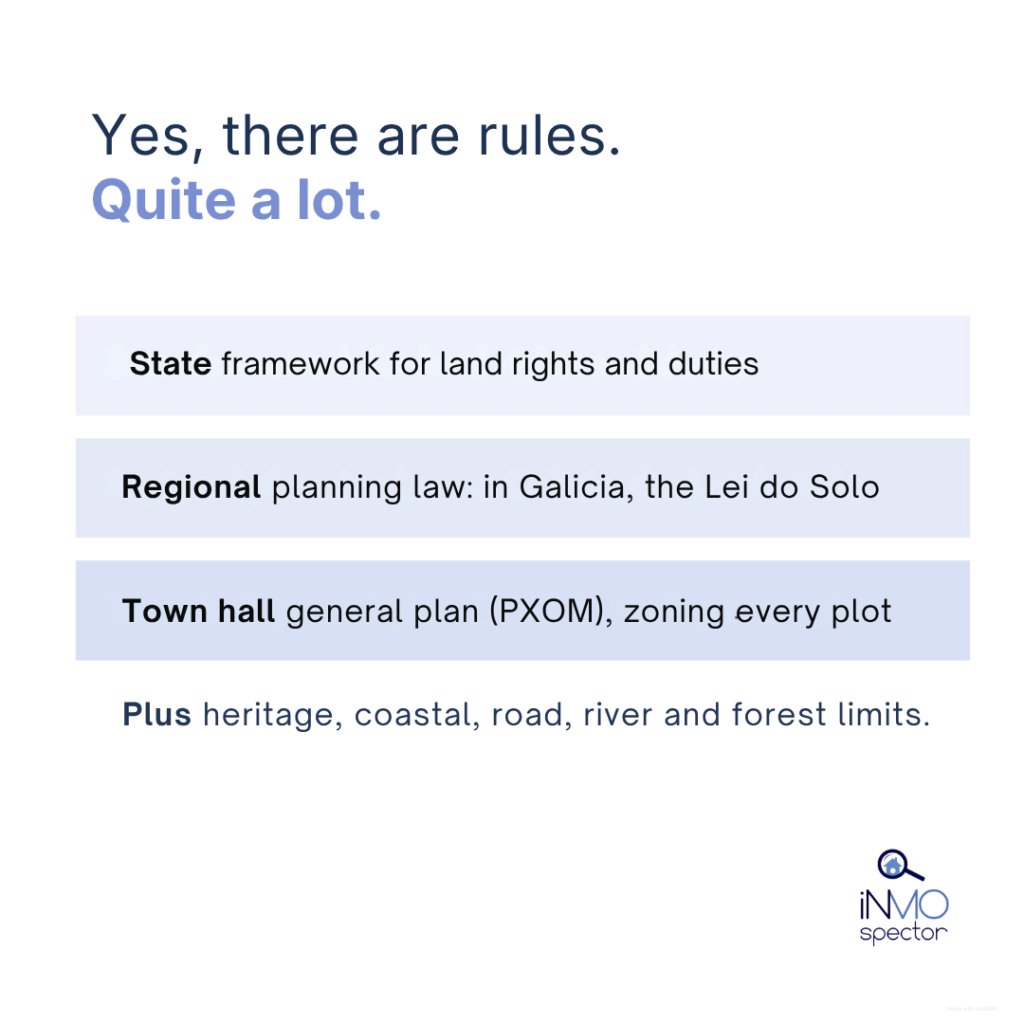
Yes, there are rules. Quite a lot of them.
Spanish urbanismo works in layers. The State sets the basic framework: the rights and duties that come with owning land, and the broad categories of land. Each autonomous community writes its own planning law; in Galicia that’s the Lei do Solo, in Asturias, Cantabria and Extremadura their own regional laws. On top of that, every municipality has its own general plan (in Galicia usually called the PXOM), which zones every plot, sets how much can be built, how high, how far from the boundary, and for what use.
So the rules are real, and they are binding. A plot on suelo rústico is treated very differently from one in a núcleo rural or on urban land. Heritage protection, coastal law, roads, rivers and forests can add their own restrictions.
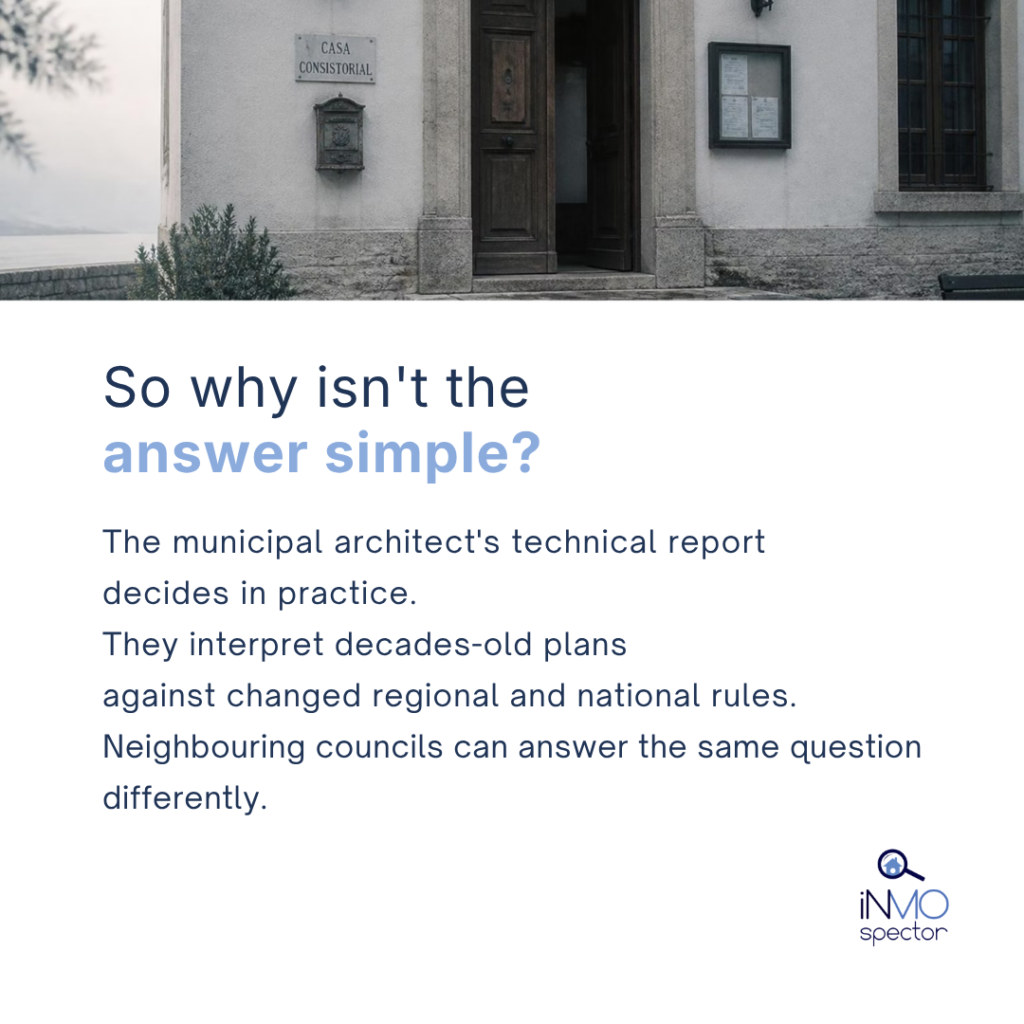
So why isn’t the answer simple?
Because rules have to be applied to a real plot and a real building, and that application is done by people.
When you ask the town hall whether you can extend, the request goes to the municipal technical staff, usually the municipal architect, who writes a technical report. Formally, the licence is granted by the mayor or the local government board. In practice, that technical report is what decides. And the architect is interpreting a plan that may be decades old, written for situations that don’t quite match your house, alongside regional and national rules that have changed in the meantime.
The result is that two neighbouring councils, applying similar rules, can reach different answers to the same question. A galería may be treated as a closed volume that counts toward the buildable area in one municipality and assessed differently in another. An old outbuilding may or may not be considered convertible. A pool may need a full licence here and a simpler procedure there. That’s not arbitrariness; it’s the nature of applying general rules to specific places. But it means urbanismo is not an exact science.
The questions clients actually ask us
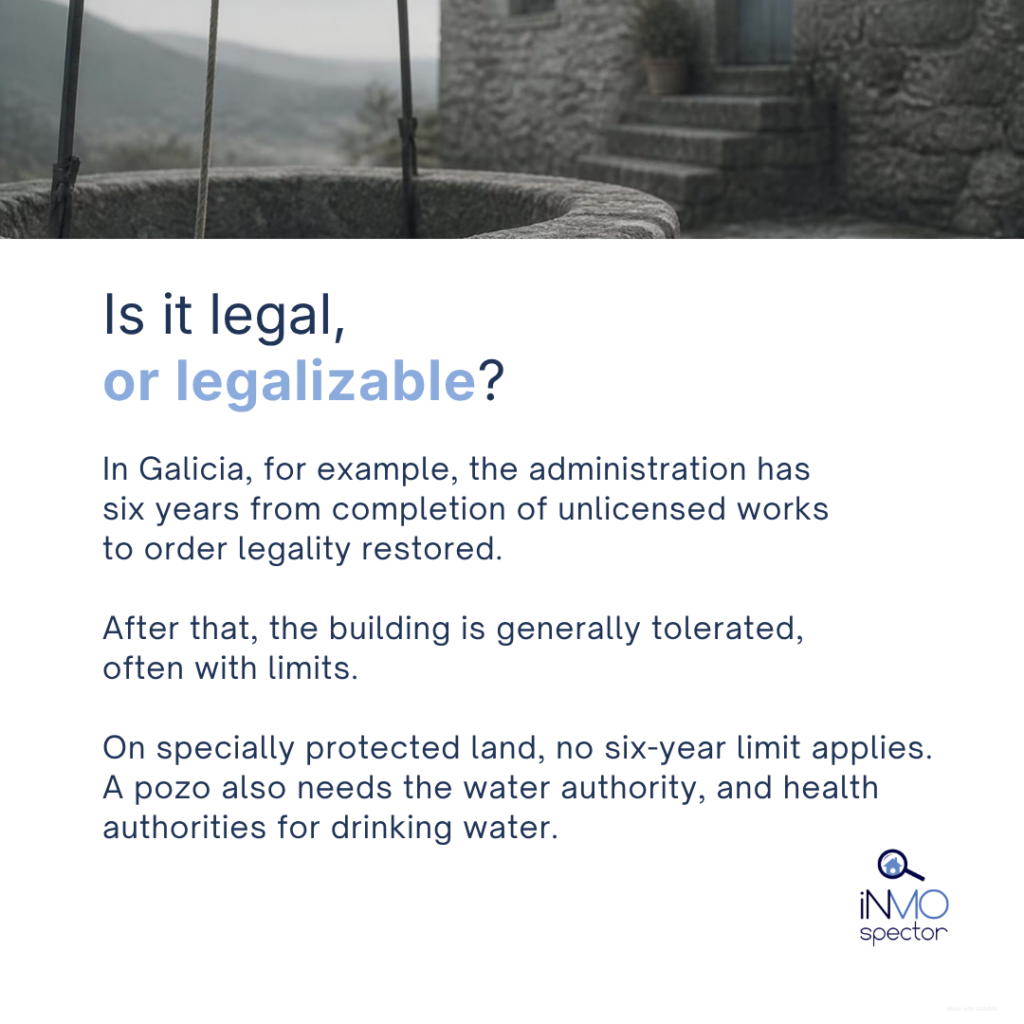
“Is it legal, or legalizable?” Many older houses have additions: a porch, an enclosed terrace, a garage turned into a room. Some had a licence, some didn’t. In Galicia, the administration has six years from the completion of unlicensed works to order that legality be restored. After that, the building is generally tolerated, but often with limits on what you can do with it later. And on specially protected land, that six-year limit doesn’t apply at all. Other regions have their own rules.
“Can I add volume?” Extending, adding a floor or closing a galería depends on how much buildable area the plan allows on your plot, how much is already used, distances to boundaries and roads, and sometimes on aesthetic conditions for traditional buildings.
“Can I build a pool or a second building?” Possible on many plots, impossible on others, especially on rustic land, where new construction is tightly controlled.
“Can I sink a pozo?” This one surprises people: a well isn’t only a municipal question. You also need the water authority, Augas de Galicia or the relevant Confederación Hidrográfica, and if the water is for drinking, the health authorities too.
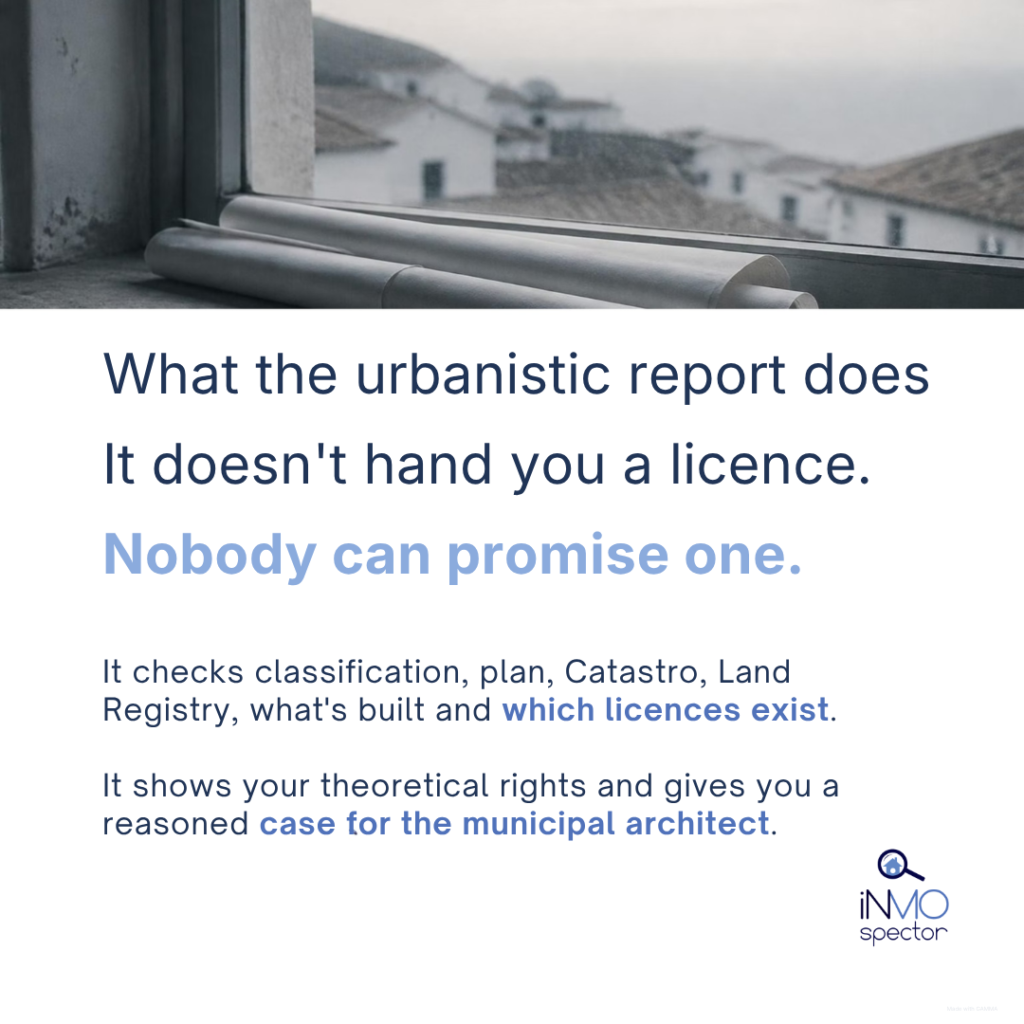
What the urbanistic report does
An urbanistic report doesn’t hand you a licence, and nobody can honestly promise you one. What it does is tell you where you stand, before you buy.
We look at the plot’s classification, the applicable plan, what’s registered in the Catastro and the Land Registry, what’s actually built, and which licences exist. From that, we can tell you your theoretical rights: what the rules allow on this plot, what looks legalizable and what doesn’t, and the realistic direction your plans can take.
Just as important, the report gives you a legal basis for argumentation. When you or we sit down with the municipal architect, you’re not asking a vague “can I?”; you’re presenting a reasoned case built on the specific rules that apply. That changes the conversation. Without it, you’re negotiating blind.
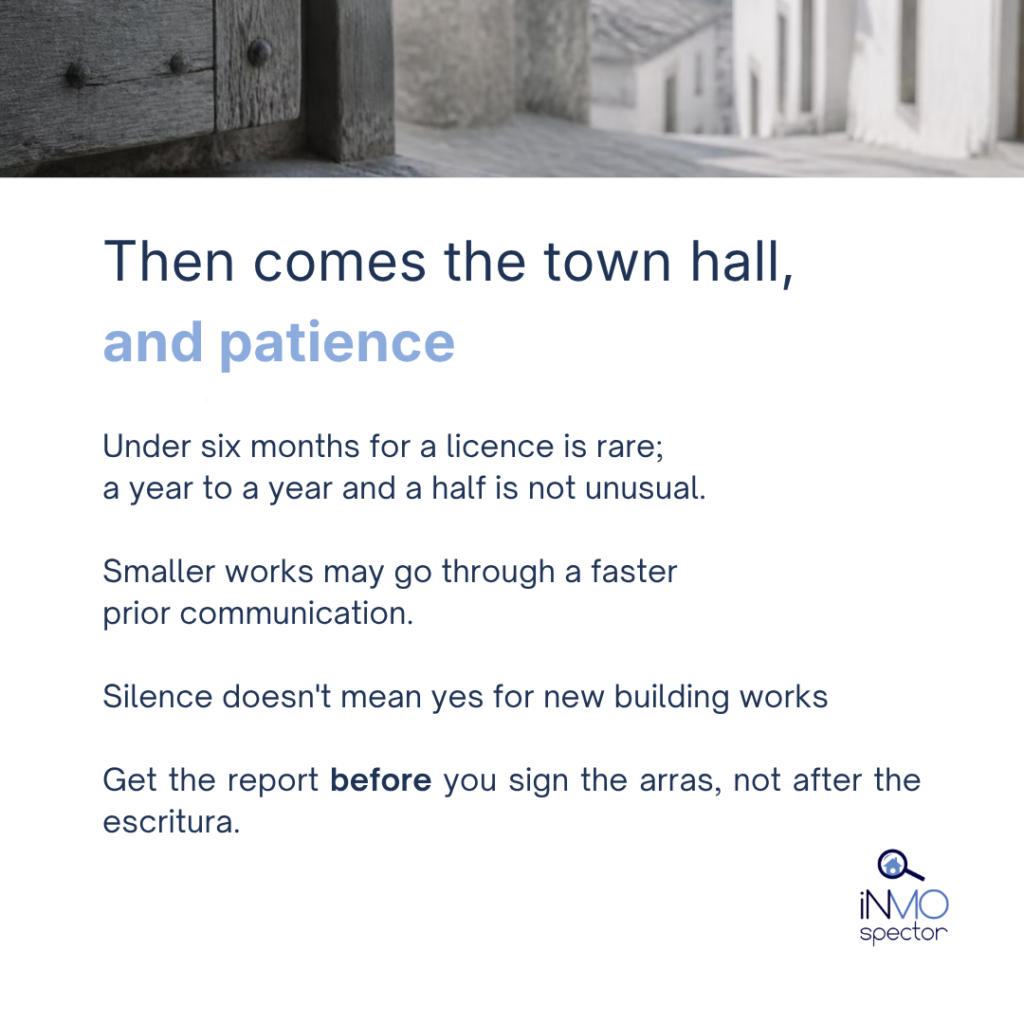
Then comes the town hall, and patience
This is where we stay with you. We help you prepare the consultation or the licence application, talk to the municipal technicians, and follow the file.
But we’ll always be honest about the pace. It’s tedious. Some municipalities work fast, others slowly. Many small councils don’t have their own architect and share one with neighbouring municipalities, often with support from the provincial Diputación, which means long queues. As a rule of thumb, it’s rare to get a licence in under six months, and a year or a year and a half is not unusual. Smaller works can sometimes go through a simpler prior communication, which is faster, but anything that adds volume or a new building needs a full licence. And silence doesn’t mean yes: for new building works, a town hall that doesn’t answer hasn’t approved anything.
That’s why the timing of the report matters so much. If your plan for a house depends on an extension, a pool or a legalization, you want to know before you sign the arras, not after the escritura.
How it fits with the rest of your purchase
The urbanistic report works best alongside our technical inspection, market valuation, pest diagnosis and energy certificate. Together they answer what you’re buying, what it’s worth, and what you’ll be allowed to do with it. With our partner lawyers, we also review your arras and escritura, and we accompany German- and English-speaking clients to the notary. And when the path is clear, our sister company iNMObuilder can take it from there: architects, licence applications, builders and the work itself.
We don’t pass or fail properties. We create transparency, so your plans for a house in Spain rest on facts, not on hope.
Thinking about a property in Galicia, Asturias, Cantabria, Extremadura or anywhere else in Spain, and wondering what you’d be allowed to do with it? Get in touch, and let’s find out before you sign.